Description
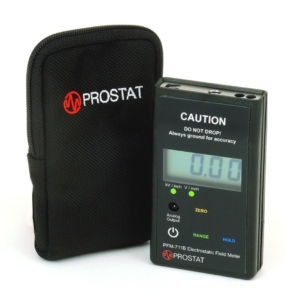
Electrostatic meters are devices used to measure the electrical charge on an object or surface. These meters are widely used in industry and research applications, such as electronics manufacturing, printing, painting, and quality control.
Electrostatic meters work by measuring the electrical charge on an object or surface using an electrostatic sensor. The sensor can be a disk or a metal plate that is electrically charged by induction when it approaches the surface being measured. The meter then measures the electrical charge on the sensor and displays it on a digital display.
There are different types of electrostatic meters, some of which can also measure the polarity of the electric charge and the electrical resistance of the surface. These devices can also offer different measurement ranges, resolutions, and accuracy.
In addition to measuring electrical charge, some electrostatic meters can also generate electrical charge to test the electrical conductivity of an object or surface.
In summary, electrostatic meters are important tools for measuring the electrical charge on an object or surface, and they can provide valuable information to improve the quality of products and processes in different industrial and research applications.
Specifications:
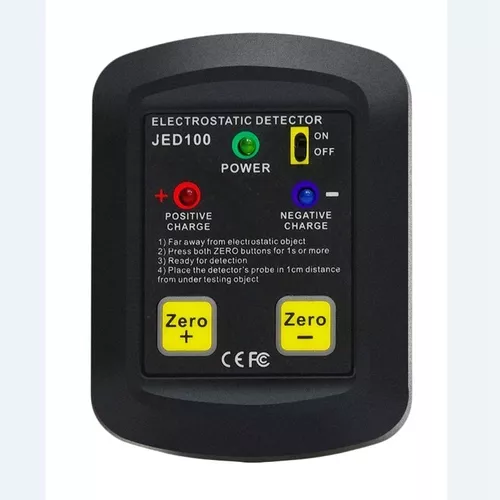
Model: JED100
Power: CR2030 double 3 V batteries.
Size: 3.150 x 2.362 x 0.984 in.
Weight: 2.68 oz.
Operating temperature: 0~122.0 °F.
Sensing range: 100V~20KV.
Measurement mode: manual non-contact measurement.
Measuring distance: 0.394 in (best).
Response time: 1S~3S.