Description
A chlorophyll meter is a device used to measure chlorophyll levels in plants. Chlorophyll is the pigment responsible for photosynthesis, the process by which plants convert sunlight into chemical energy.
These devices use a non-destructive technique to measure the amount of chlorophyll in plant leaves without damaging them.
The basic operation of a chlorophyll meter is based on the absorption of light by chlorophyll. Chlorophyll primarily absorbs light in the wavelengths of red and blue, while reflecting green light. The meter emits a light source with specific wavelengths and measures the amount of light reflected by the plant’s leaves. Based on this measurement, the meter calculates the chlorophyll index, which is a quantitative measure of the amount of chlorophyll present.
The information provided by a chlorophyll meter can be useful in various fields, such as agriculture, ecology, and scientific research. For example, in agriculture, chlorophyll meters are used to assess crop health, photosynthetic efficiency, and nutrient needs. In scientific research, these devices are used to study the response of plants to different environmental conditions and to monitor plant stress.
It is important to note that chlorophyll meters are precision tools and their proper use requires correct calibration and proper interpretation of the results. In addition, portable chlorophyll meters vary in their technology and features, so it’s a good idea to check the manufacturer’s instructions for specific information about the device you’re using.
DESCRIPTION:
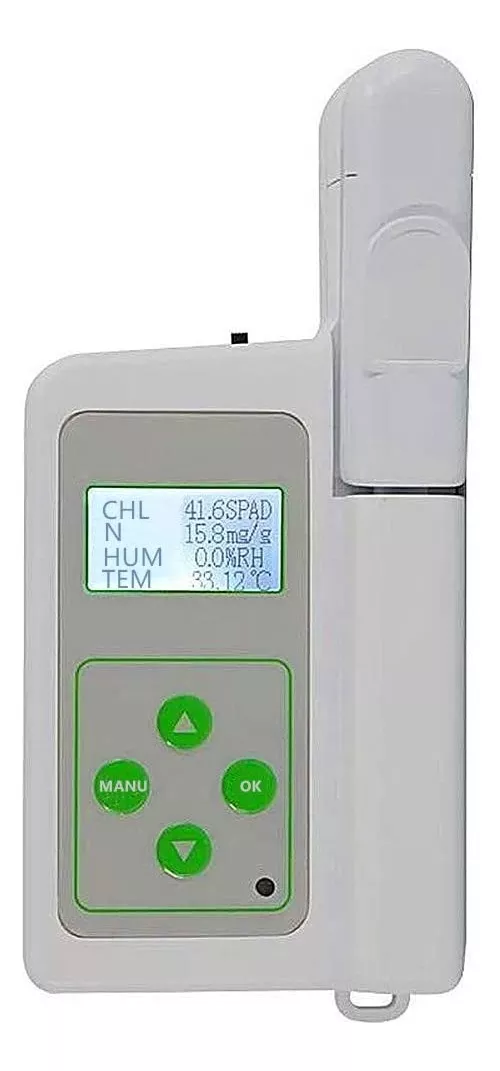
The TYS-B plant chlorophyll meter can measure the relative chlorophyll content of the plant (SPAD unit) or the “greenness level” so that it can know the actual nitro requirement of the plant and help you understand if the nitro deficiency level of the soil or if the nitrogen fertilizer is being applied too much.
You can use this instrument to increase nitrogen fertilizer utilization and protect the environment (prevent environmental pollution, especially water pollution, by applying too many nitrogen fertilizers).
WORKING PRINCIPLE:
Two LED light sources emit two types of light, one is red light (650nm), and the other is infrared light (940nm). Two types of light penetrate the leaf and hit the receiver.
The light signal is converted to an analog signal. The analog signal is amplified and converted into a digital signal by an analogue/digital converter.
The digital signal is processed by the microprocessor and the SPAD value is calculated and displayed on the LCD screen.
TECHNICAL DATA:
Measurement range: 0.0-100 SPAD.
Measuring area: 0.079 x 0.079 in.
Measurement accuracy: within 1 SPAD unit (0.0-50.0 SPAD under normal temperature and humidity).
Repeatability at +0.3 SPAD units (0.0-50.0 SPAD measurement position unchanged)
Data Storage Media: SD Card Storage
Data storage capacity: 2 GB.
Power: 4.2 V rechargeable lithium battery.
Battery capacity: 800 mAh.
Weight: 9.17 oz.
Product size: 5,512 x 3,346 x 1,772 in.
Working and Storage Environment: 32.0 – 122.0 °F; 85% relative humidity
Measuring range: chlorophyll: 0.0-99.9SPAD;
nitrogen content: 0.0-99.9MG/G;
leaf surface moisture: 0.0-99.9RH%;
Leaf Surface Temperature: 14.0-211.8°F;
Measuring area: 0.079 in x 0.079 in.
High precision: within 1 SPAD unit.
30 data is collected automatically and the average value is calculated and displayed at the same time.
Function: Suitable for measuring the relative chlorophyll content of the plant (SPAD unit) or “greenness level”.
High sensitivity: the measurement time interval is less than 3 seconds.
Easy to use: rechargeable lithium battery for easy transport.