Description
An oscilloscope is a test and measurement instrument used in electronics to visualize and analyze time-varying electrical signals. It provides a graphical representation on a screen, called a trace, that shows how a signal varies over time.
Basic operation: An oscilloscope samples an electrical signal and plots it on a Cartesian graph. The vertical axis shows the amplitude of the signal, while the horizontal axis represents the time. This allows the waveform of the signal to be visualized, as well as to measure parameters such as amplitude, frequency, period, rise time, decay time, among others.
Digital Oscilloscopes:
They convert the analog signal into a digital form for processing, display, and storage. They can be storage or real-time sampling.
Important features:
Bandwidth: Indicates the ability of the oscilloscope to display high-frequency signals accurately.
Sampling Rate: Determines the number of dots per second that the oscilloscope can capture and render on screen.
Vertical Resolution: Defines how accurately the amplitude of the signal can be measured.
Memory and Storage Capacity: Allows waveforms to be captured and stored for later analysis.
Applications:
Diagnosis and troubleshooting of electronic circuits.
Design and development of electronic circuits.
Tests and measurements in telecommunications, power electronics, control systems, among others.
Additional functionalities:
Trigger: Allows you to synchronize the display of the signal based on a specific event.
Mathematical analysis: Allows mathematical operations to be performed on waveforms, such as addition, subtraction, multiplication, and Fourier transforms.
Automatic measurements: Provides built-in functions for measuring waveform parameters such as amplitude, period, and frequency.
ABOUT THE EQUIPMENT AND MODEL:
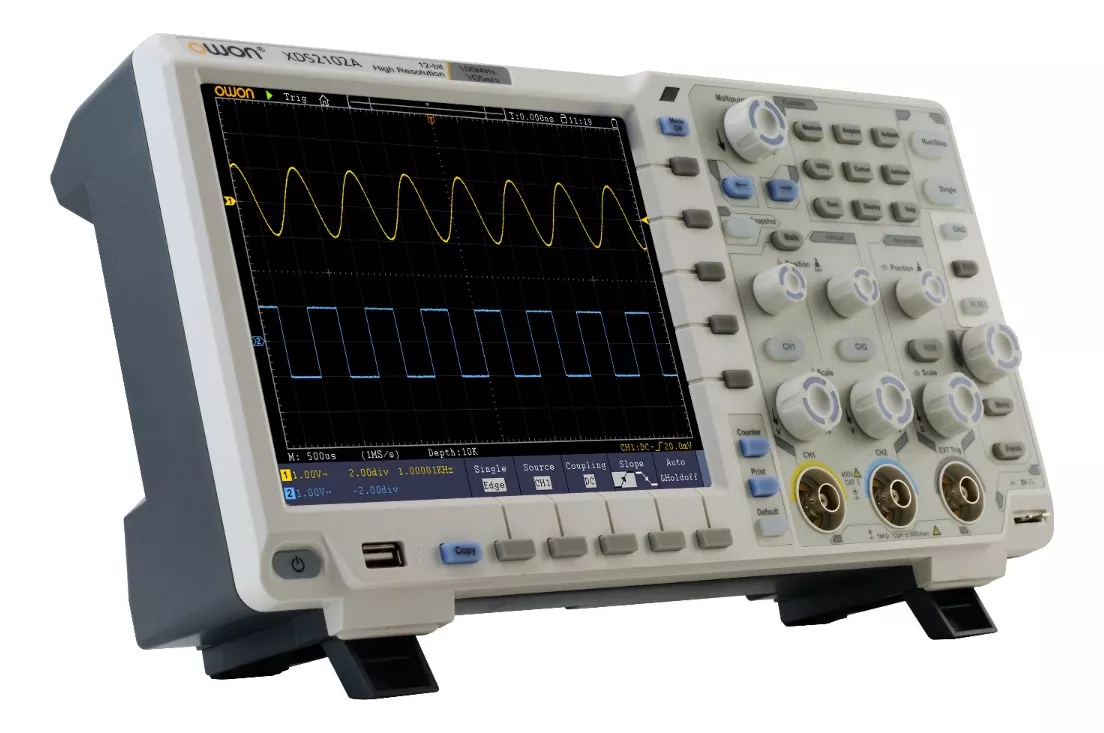
The Owon XDS2102A is a digital oscilloscope of the Owon brand. Here’s some information about its key features:
Display: It features an 8-inch TFT color display with 800×480 pixel resolution, which offers a clear display of waveforms and data.
Channels: The XDS2102A is a 2-channel oscilloscope, which means it can display and analyze two different signals simultaneously.
Bandwidth: It has a bandwidth of 100 MHz, which means it can capture signals with frequencies up to 100 MHz.
Sample rate: The real-time sample rate is 1 GS/s (gigasamples per second) per channel. This allows for accurate representation of waveforms even at high frequencies.
Memory: It has a waveform memory of 10 Mpts (megasamples), which allows detailed waveforms to be captured and stored for later analysis.
Measurement Functions: The oscilloscope offers a wide range of measurement functions, including peak-to-peak voltage, frequency, period, pulse width, duty ratio, and more.
Connectivity: It has USB and LAN ports, which allows connection and communication with other devices, such as computers, to transfer data or remote control.
Additional Functions: The Owon XDS2102A has a variety of additional features, such as math functions, advanced triggering, USB waveform storage, search and markers, and a built-in signal generator.
User Interface: Features an intuitive and easy-to-use interface, with ergonomic buttons and knobs, as well as easy menu navigation.
Applications: This oscilloscope is suitable for a wide range of applications in fields such as electronics, telecommunications, research and development, education, among others.
TECHNICAL SPECIFICATIONS
100 MHz band switch
Sample Rate 1GS/s
Vertical resolution (A/D) 12-bit
Register length 40M
Waveform refresh rate 75,000 wfms/s
Horizontal scale 2ns/div – 1000s/div step from 1 – 2 – 5
Rise time (at input, typical) = 1.7 ns
8,800 x 600 pixel color LCD display
External 2+1 channel; Channel isolation 50Hz : 100 : 1, 10MHz : 40 : 1
Maximum input voltage 1MO = 300 Vrms; 50O = 5Vrms
Auto, Normal, and Single Shooting Mode
Frequency counter available
Power supply 100 V – 240 V AC, 50/60 Hz, CAT II
Power consumption <15W
2A fuse, class T, 250V
3.7V, 13200mAh battery (NOT INCLUDED)